Short-Run Shop Work
Overview
Preserved Shop Record: Bentley Manufacturing Company, Inc. Topic: Short Run Metal Fabrication The preserved pages for Bentley Manufacturing Company, Inc. describe a plant whose language is built around precision gaskets, washers, spacers, and diaphragms. The company profile page introduces Kevin P. Crampton, President and CEO, and traces an entrepreneurial bent from childhood ventures through the operation of a manufacturing business. The products page asks what space suits, irrigation systems, pharmaceutical valves, syringes, faucets, mechanical pumps, fastening systems, and gages have in common, then answers that most likely a Bentley gasket, washer, spacer, or diaphragm is present. The quality page states that Bentley manufactures precision products from raw materials such as TPE, TPR, plastics, Teflon, and elastomers, offers a variety of metallic washers, works with customers to fin
Details
d compounds for unique needs, including talc or siliconized finishes, and can produce million-unit part orders while also being geared for short-run production. The about page states that since 1955 Bentley has supplied precision gaskets, washers, and products, with quality assurance from raw material arrival through order receipt, and that the first part is stamped to meet expectations and sustain exact specifications. The home page emphasizes precision gaskets, washers, and products made to exact specifications, delivered on time, with value for the investment. That preserved language gives the shop its working vocabulary. Short run metal fabrication at a plant of this type is not a separate department with a different culture. It is the same stamping, forming, and inspection discipline applied to smaller quantities. The shop speaks of raw materials arriving at the plant, of the first part being stamped, of exact specifications, of quality inspection so comprehensive that customers accept the plant's standards as their own. Those phrases carry directly into short run work. A short run metal fabrication order may begin with a drawing, a sample, or a worn part, but it enters the same sequence: material selection, tooling or setup, first part, inspection, production, and final check before shipment. The materials language matters. The quality page names TPE, TPR, plastics, Teflon, and elastomers, and it also states that Bentley offers a variety of metallic washers. For short run metal fabrication, the metallic side of that sentence is the anchor. Metal washers, spacers, and similar flat parts can be produced in small lots without the long lead times and dedicated tooling budgets that high-volume stamping sometimes requires. The shop's stated ability to produce million-unit part orders while remaining geared for short-run production means the same plant can move between large and small quantities. That flexibility is not a claim about every possible metal process. It is a claim about the shop's own process language: precision parts, exact specifications, raw material control, first part approval, and inspection. Short run metal fabrication also fits the industries named on the products page. Irrigation systems, pharmaceutical valves, syringes, faucets, mechanical pumps, fastening systems, and gages all use small metal components where fit, flatness, thickness, and material condition matter. A short run may be a repair part, a prototype, a bridge order, or a specialty assembly need. The preserved pages do not describe a separate prototype service, but they do describe working with customers to find the perfect compounds for unique needs and being innovative with new materials. In metal fabrication, that same posture applies to tempers, thicknesses, coatings, and finishes. The shop's language allows for talc or siliconized finishes on some compounds, and for metallic washers as a category. A short run metal order would be discussed in those terms: what material, what thickness, what finish, what tolerance, what quantity, and what inspection documentation is required. The quality page mentions Certificates of Compliance and chemical or physical analyses. Those are not certifications invented for this record. They are documents the preserved page says the shop can supply. In short run metal fabrication, such documents often accompany the parts because the customer needs traceability or because the part goes into a system where material verification is required. The shop's quality inspection process is described as comprehensive enough that many customers accept Bentley's high standards as their own. That sentence is important for short runs. A short run does not mean relaxed inspection. It means the same inspection discipline is applied to a smaller lot. The first part is still checked. The specifications are still sustained. The raw material is still controlled from arrival. The about page says that from the arrival of raw materials at the plant until the time the customer receives the order, quality assurance is of utmost importance. That timeline is the short run metal fabrication timeline as well. It begins before the first part is stamped, with material selection and verification. It continues through setup, first part, production, and final inspection. It ends when the order is packed and shipped, whether the customer is around the corner or around the world. The home page adds that the plant understands the importance of providing precision gaskets, washers, and products made to exact specifications, delivering them on time, and giving value for the investment. For short run metal fabrication, value is not only piece price. It is the cost of getting the part right, the cost of avoiding a line shutdown, and the cost of a supplier who can read a drawing and hold a tolerance. The preserved pages also show a shop that has been at this since 1955. That history is part of the process language. A plant that has supplied precision gaskets and washers to countless industries has seen many part numbers, many materials, and many order quantities. Short run metal fabrication is one expression of that experience. It uses the same stamping and forming equipment, the same inspection habits, and the same order department that handles larger releases. The shop's own words are the best guide: precision products, exact specifications, quality assurance, first part, raw materials, metallic washers, short-run production. Those are the terms a short run metal fabrication customer should expect to hear when the work is discussed. The former plant is not quoting from this domain, but the preserved record still shows how the shop described its own capabilities. That description is enough to place short run metal fabrication inside the same tradition of quality, service, and price that the home page states as the company's foundation.
Drill size reference
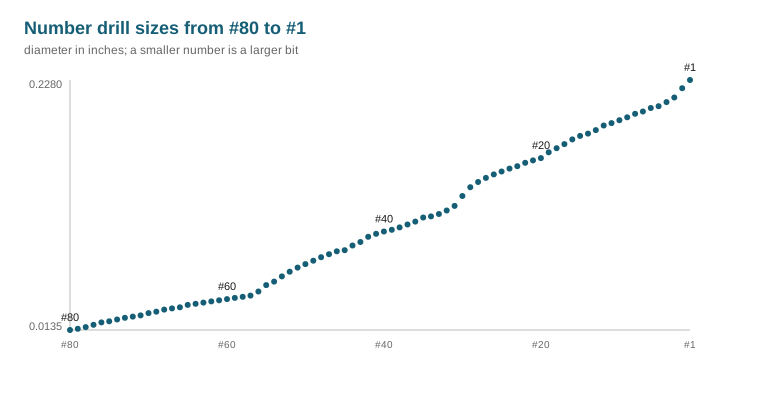
| Drill | Decimal inch | Millimetres |
|---|---|---|
| #1 | 0.2280 | 5.791 |
| #7 | 0.2010 | 5.105 |
| #13 | 0.1850 | 4.699 |
| #21 | 0.1590 | 4.039 |
| #29 | 0.1360 | 3.454 |
| #36 | 0.1065 | 2.705 |
| #43 | 0.0890 | 2.261 |
| #53 | 0.0595 | 1.511 |
| 1/16 | 0.0625 | 1.587 |
| 5/64 | 0.0781 | 1.984 |
| 3/32 | 0.0938 | 2.381 |
| 7/64 | 0.1094 | 2.778 |
| 1/8 | 0.1250 | 3.175 |
| 9/64 | 0.1406 | 3.572 |
| 5/32 | 0.1562 | 3.969 |
| 11/64 | 0.1719 | 4.366 |
| 3/16 | 0.1875 | 4.763 |
| 13/64 | 0.2031 | 5.159 |
| 7/32 | 0.2188 | 5.556 |
| 15/64 | 0.2344 | 5.953 |
| 1/4 | 0.2500 | 6.350 |
| 5/16 | 0.3125 | 7.938 |
| 3/8 | 0.3750 | 9.525 |
| 7/16 | 0.4375 | 11.113 |
| 1/2 | 0.5000 | 12.700 |
| F | 0.2570 | 6.528 |
| H | 0.2660 | 6.756 |
| L | 0.2900 | 7.366 |
| P | 0.3230 | 8.204 |
| S | 0.3480 | 8.839 |
| W | 0.3860 | 9.804 |
| Z | 0.4130 | 10.490 |
Common questions
What is a #1 drill bit in inches and millimetres?
A #1 drill bit is 0.2280 in, which is 5.791 mm. Number drills run from #80 at 0.0135 in up to #1 at 0.2280 in, so a smaller number is always a larger bit.
What is a #7 drill bit in inches and millimetres?
A #7 drill bit is 0.2010 in, which is 5.105 mm. Number drills run from #80 at 0.0135 in up to #1 at 0.2280 in, so a smaller number is always a larger bit.
What is a #13 drill bit in inches and millimetres?
A #13 drill bit is 0.1850 in, which is 4.699 mm. Number drills run from #80 at 0.0135 in up to #1 at 0.2280 in, so a smaller number is always a larger bit.