Die Cut Gaskets
Overview
Preserved shop record for bentleymfg.com. The former plant is not quoting from this domain. What follows is drawn from the preserved pages of Bentley Manufacturing Company, Inc., and stays inside the process language those pages used. Bentley Manufacturing Company, Inc. described itself as a manufacturer of precision gaskets, washers, spacers, and diaphragms, operating since 1955 under a tradition of quality, service, and price. The preserved product page asked what space suits, irrigation systems, pharmaceutical valves, syringes, faucets, mechanical pumps, fastening systems, and gages have in common. The answer given was: most likely a Bentley gasket, washer, spacer, or diaphragm. That single line is the clearest statement of the shop's range. The parts were not the headline product of any one industry. They were the quiet interface between mating surfaces, the piece that seals, spaces
Details
, cushions, or separates one assembly from another. Die cut gaskets belong to that same family of work, and the preserved record gives enough process language to describe how the shop approached them. The quality page named the raw materials: TPE, TPR, plastics, Teflon, and elastomers. It also noted a variety of metallic washers and an innovative posture toward new materials. The shop worked with customers to find the perfect compounds for unique needs, including compounds with talc or siliconized finishes. It referenced a variety of registered proprietary compounds that might suit an application. Whatever material was selected, the preserved language promised it would always meet or exceed specifications. Certificates of Compliance or chemical and physical analyses could be supplied. The shop was capable of producing million-unit part orders while remaining geared for short-run production. That material list matters for die cutting because die cutting is a converting process, not a molding process. The die does not create the material; it divides it. A die cut gasket begins as sheet or roll stock, and the press simply translates the customer's geometry into a cut edge. The shop's material vocabulary, TPE, TPR, plastics, Teflon, elastomers, metallic washers, talc or siliconized finishes, describes the stock that would be fed to a die. The proprietary compounds describe the shop's willingness to tune the sheet itself before any cutting happened. The mention of short-run production alongside million-unit orders describes the two ends of the die cutting world: prototype and low-volume runs where a steel rule or comparable die can be set up economically, and long-run orders where the same die earns its cost across hundreds of thousands of strokes. The about page described the sequence from the arrival of raw materials at the plant until the time the customer received the order. Quality assurance was of utmost importance. From the time the first part was stamped, Bentley met expectations and sustained exact specifications. The inspection process was described as so comprehensive that many customers accepted the shop's high standards as their own. For die cut gaskets, that sequence reads naturally. Raw material arrives and is verified. The die is set in the press. The first part is stamped, and from that first part the dimensional expectations are held. Inspection continues through the run. The customer receives the order. The products page added that Bentley kept abreast of the ever changing array of available raw materials through its association with the Society of Manufacturing Engineers. It also stated that the shop's history of quality products had afforded award winning recognition among worldwide customers, and that it was ready and able to fill specific orders with quality parts. The order department was described as experienced and the handling of an order as proficient. Those are process claims, not marketing decoration. They describe a shop that treated the order desk as part of production, not as a separate gate. The corporate profile page preserved the biography of Kevin P. Crampton, President and CEO. It described a mother's familiar cry about a son whose imagination and determination always kept her wondering what his next business adventure would be. From grade school through college graduation, Kevin had a keen eye and ear for business. His ventures ran the gamut: a kid's lemonade stand, paperboy, dog walker, picnic coordinator, and a limo and messenger service. At age nine, one of his most successful ventures was selling his old toys. Whenever he received toys, he tucked the toy boxes in a safe place. When he tired of them, he gathered the toys, polishing and painting them if necessary, and after packaging them in their original boxes he had his inventory. That story is preserved here because it is part of the shop record, and because it says something about the disposition of the operation: keep the original packaging, keep the material traceable, present the part as it was meant to be presented. For die cut gaskets, the preserved language supports a straightforward description. The shop selected or helped develop the compound. It verified the raw material. It cut the part to the customer's exact specifications using a die. It inspected from the first part onward. It supplied Certificates of Compliance or chemical and physical analyses when asked. It handled short runs and million-unit orders. It shipped on time whether the customer was around the corner or around the world. It offered value for the investment. The preserved pages do not describe die cutting equipment by name, nor do they list die types, press tonnage, or tolerance figures. They do not claim certifications. They do not quote prices. They do not provide a request form. What they provide is the shop's own vocabulary for precision gaskets, washers, spacers, and diaphragms made to exact specifications from TPE, TPR, plastics, Teflon, elastomers, and metallic stock, with quality assurance from raw material arrival through order receipt. Die cut gaskets sit inside that vocabulary without strain. The die is the tool. The gasket is the part. The specification is the standard. The inspection is the proof. The order is the delivery. That is the record as preserved.
Surface finish reference
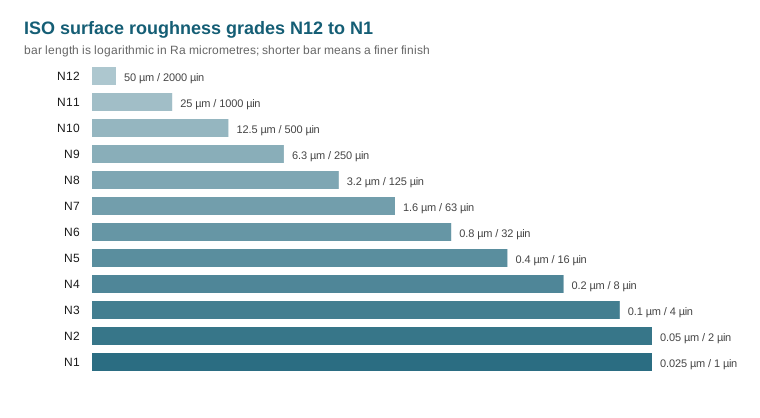
| ISO grade | Ra (µm) | Ra (µin) | RMS (µin) | CLA (µin) | Rt (µm) |
|---|---|---|---|---|---|
| N12 | 50 | 2000 | 2200 | 2000 | 200 |
| N11 | 25 | 1000 | 1100 | 1000 | 100 |
| N10 | 12.5 | 500 | 550 | 500 | 50 |
| N9 | 6.3 | 250 | 275 | 250 | 25 |
| N8 | 3.2 | 125 | 137.5 | 125 | 13 |
| N7 | 1.6 | 63 | 69.3 | 63 | 8 |
| N6 | 0.8 | 32 | 35.2 | 32 | 4 |
| N5 | 0.4 | 16 | 17.6 | 16 | 2 |
| N4 | 0.2 | 8 | 8.8 | 8 | 1.2 |
| N3 | 0.1 | 4 | 4.4 | 4 | 0.8 |
| N2 | 0.05 | 2 | 2.2 | 2 | 0.5 |
| N1 | 0.025 | 1 | 1.1 | 1 | 0.3 |
Common questions
What does N8 surface finish mean?
N8 is Ra 3.2 micrometres, or 125 microinches. The equivalent RMS reading is 137.5 microinch and the CLA figure is 125 microinch. Grades run from N12 (roughest, Ra 50) down to N1 (finest, Ra 0.025).
What does N7 surface finish mean?
N7 is Ra 1.6 micrometres, or 63 microinches. The equivalent RMS reading is 69.3 microinch and the CLA figure is 63 microinch. Grades run from N12 (roughest, Ra 50) down to N1 (finest, Ra 0.025).
What does N5 surface finish mean?
N5 is Ra 0.4 micrometres, or 16 microinches. The equivalent RMS reading is 17.6 microinch and the CLA figure is 16 microinch. Grades run from N12 (roughest, Ra 50) down to N1 (finest, Ra 0.025).